There is a document sitting in a library in Nashville, Tennessee.
It was printed in 1807 by a group called the Society for the Conversion of Negro Slaves. They called it Select Parts of the Holy Bible for the Use of the Negro Slaves in the British West-India Islands.
When researchers opened it, they found something that stopped them cold. Ninety percent of the Old Testament had been cut out. The entire book of Exodus — the story of God hearing the cries of enslaved people and sending someone to set them free — was completely gone.
Not lost. Not misplaced. Removed on purpose.
What was left behind was a small collection of passages chosen for one reason only: to keep people calm, obedient, and convinced that God wanted them to stay in chains.
"Servants, obey your masters."
"Be content in whatever situation you find yourself."
Researchers gave this document the name it deserved.
The Slave Bible.
Most people who hear about the Slave Bible assume it was some extreme, isolated thing — something that happened once in 1807 and stayed there.
What they don't know is that the editing started over 200 years earlier. And it never fully stopped.
In this article:
- The king who rewrote the Word of God
- The one nation they could never touch
- The 22 books removed from Western Christianity
- The 18 years nobody talks about
- Why this was kept from you
- What women said after reading it for the first time
- Two paths from this moment
The king who rewrote the Word of God
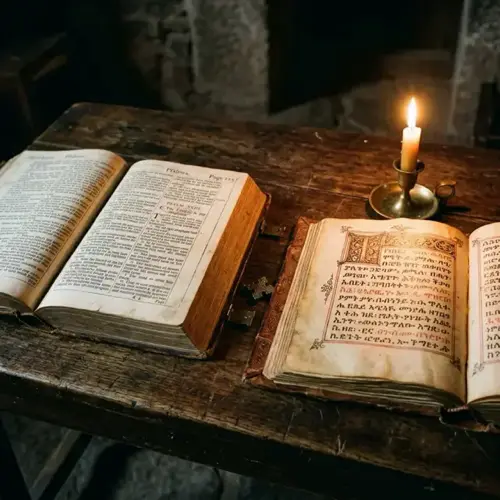
In the year 1604, King James I of England called a meeting of 54 scholars and told them to produce a new translation of scripture.
King James was not a neutral man with a passion for theology. He was a king who believed in the divine right of rulers — the idea that God had personally placed him above other people and that questioning him was the same as questioning God. He was also a man whose country was building enormous wealth through the buying and selling of human beings.
The translators he hired understood what kind of translation he wanted. They got to work.
The 1611 decision/Lily Yeh/TAR
Every serious Hebrew scholar in 1611 knew the word Yahweh and exactly what it meant. This was not a translation error. Every Sunday, when the pastor stands at the front of the church and says "the Lord your God" — he is using a title that came from that decision. Not because he is evil. Not because he knows. Because nobody told him either.
The editing happened so long ago, and got passed down so many times, that most of the people inside those churches have no idea they are holding a book that was already changed before it ever reached their grandmother's hands.
And this is the part that tends to stop people completely. Because right here is where a very uncomfortable question shows up.
If the Bible I grew up with was edited — then what did the original say? Who kept the full version? And why has nobody told me this before?
Those questions have real answers.
The one nation they could never touch
The country no colonial power could reach/Lily Yeh/TAR
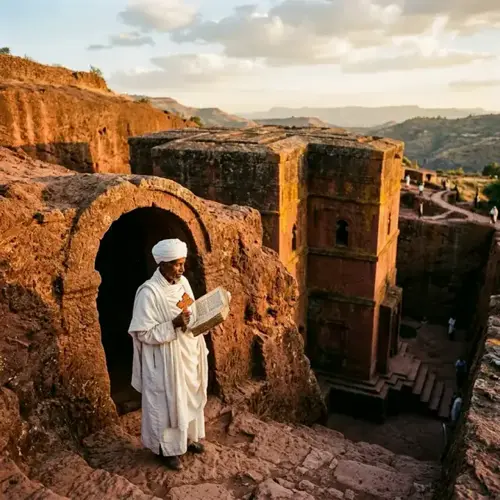
There is a country in East Africa where the story of Christianity looks completely different. Ethiopia.
Ethiopia is the only African nation that was never colonized by a European power. When European countries were dividing up the African continent and deciding what its people would be allowed to believe, own, and read — Ethiopia held them off. Its mountains were too steep. Its warriors were too fierce. Its people were too ancient and too organized to be taken.
And because Ethiopia was never colonized, something remarkable happened. Its Bible was never edited.
The Ethiopian Orthodox Tewahedo Church was founded in the 4th century — around 330 AD. This is not a new religion. This is the oldest continuously practicing Christian institution on the planet, 300 years older than the Roman Catholic Church as we know it.
When the Council of Nicaea met in 325 AD — the gathering where Roman and European church leaders decided which books belonged in the Bible and which ones would be removed — the Ethiopian church was already established. They did not attend. They did not accept the decisions made there.
They kept every book.
The 22 missing books/Lily Yeh/TAR
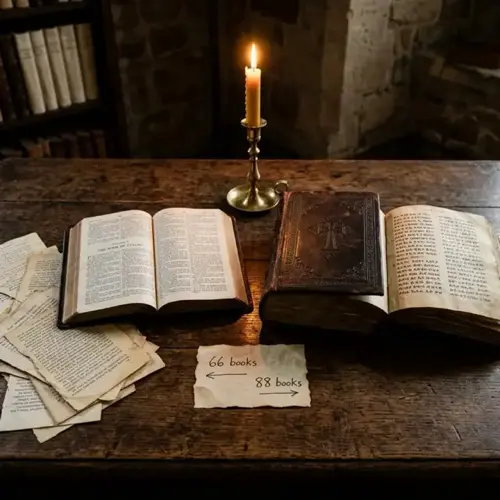
The 22 books removed from Western Christianity
Your grandmother held a Bible that had already been edited twice before it reached her hands. First in 1611, when a British king replaced the name of God 6,828 times. Then in 1807, when that already-edited version was cut down even further — specifically to keep Black people from reading the parts that remained.
She survived Jim Crow on the verses that were left behind after both rounds of editing. She raised her children and buried her loved ones and kept her faith intact through whatever passages the editors decided were safe to leave in.
That is a testament to her strength — not to the completeness of what she was handed.
The 18 years nobody talks about
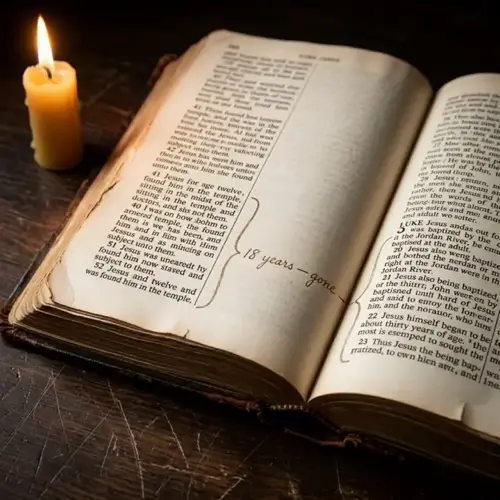
The gap that was never explained/Lily Yeh/TAR
Open any King James Bible to the Gospel of Luke. You will find the story of Jesus at age 12, sitting in the temple in Jerusalem, speaking with the teachers there. Then turn the page. The next time Jesus appears in the KJV, he is 30 years old and walking to the Jordan River to be baptized.
Eighteen years. Gone. No explanation. No account. No record of where he went, what he learned, who he lived among, or what those years produced in the man who would change the course of human history.
For decades, people who asked about this gap inside their churches were told the same thing: "We simply don't know. God didn't see fit to reveal it."
That answer was accepted because most people had no idea there was another record.
The Ethiopian Bible does not have that gap. Inside the Ethiopian canon are texts that document the full life, the full lineage, and the full spiritual context of the person at the center of the faith. The Book of Jubilees gives a complete genealogical account of the patriarchs of scripture, placing them on an African calendar, in a spiritual tradition that predates the Roman Empire by thousands of years.
These are ancient manuscripts, written in Ge'ez — the oldest surviving Semitic language — copied by hand for over 1,600 years inside monasteries that were already ancient when Columbus was born.
Why this was kept from you
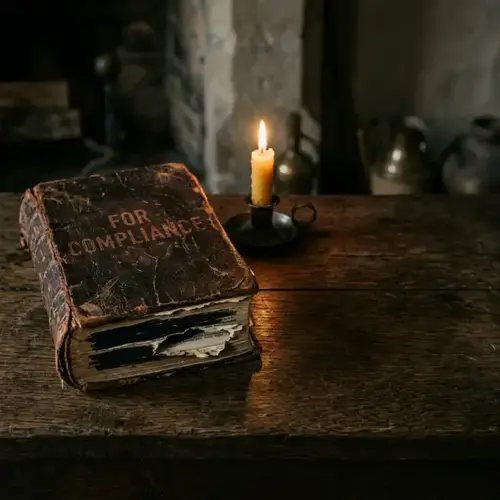
The specific reason/Lily Yeh/TAR
A complete Bible is harder to control than an incomplete one.
The Book of Enoch describes angels who were given authority and chose to abuse it — who took power that did not belong to them and were judged severely for it. The Book of Jubilees describes God's people as a specific lineage with a specific heritage rooted in Africa — not in the imaginary European landscapes that 500 years of Western religious paintings placed the stories inside. The Book of Meqabyan tells the story of people who refused to bow to unjust rulers, who chose death over compliance, and who were vindicated by the God who saw what was done to them.
Every one of these books tells the same story the Slave Masters needed people not to believe:
That God sees the oppressed. That God judges the powerful who abuse their position. That the people who were told they were nothing have an ancient, documented, unbroken inheritance that no king could reach — because it was preserved in a country no king could conquer.
"I thought I was losing my faith. I was just outgrowing the box."
If you have spent the last year — or the last several years — feeling like you were falling away from God, feeling guilty for asking questions, feeling like something was wrong with you because the church you grew up in stopped feeling like home...
You were not falling away from God. You were outgrowing a container that was never built for you. The faith is not the problem. The edited version of the book is the problem.
I cried for two hours after I opened it. Not because I was sad. Because I finally felt like God had always been speaking to me — and someone had just been holding their hand over my ears.
I grew up being told that my ancestors were saved when they were brought to this country and given the Bible. Reading the Ethiopian canon was the first time I understood that my ancestors had their own relationship with God thousands of years before any ship crossed any ocean.
The KJV felt like a letter that had already been opened, read, and edited by someone else before it reached me. This felt like the original.
I didn't lose my faith. I found more of it.
This is not a new religion. This is the original one.
The Ethiopian Orthodox Church has been practicing Christianity continuously since 330 AD — almost 400 years before Islam was founded, almost 800 years before the first European crusade, and over 1,200 years before King James commissioned his translation. They baptize in the name of the Father, the Son, and the Holy Spirit. They observe the Sabbath. They fast more days per year than any other Christian denomination on earth.
This is not a departure from Christianity. This is the oldest branch of Christianity that exists. And it belongs to Africa.
Two paths from this moment
You will still be sitting with those same questions tomorrow morning. The gap in Luke will still be there. The 6,828 replacements will still have happened. The 22 missing books will still be missing from the copy on your shelf. The information in this article does not un-become true because you close the tab. And at some point — maybe tonight, maybe six months from now at 2 AM — you will find yourself back here, still looking for the same answer.
Hold the unedited record in your hands and read, for the first time, the full version of the story your ancestors knew. The gap in Luke gets filled in. The name that was replaced 6,828 times gets restored. You sit with a Bible that was never approved by a slave-owning king, never edited for a captive audience. The women who chose this path describe it the same way every time — not as finding something new. As finally getting back something old.
Following the publication of Osei's prior work on biblical suppression, we received a high volume of reader correspondence asking which specific edition of the Ethiopian Bible meets all five criteria. The Complete Ethiopian Bible in English — available through the link below — is the edition our editorial team reviewed and confirmed against these criteria.
It contains all 88 books, translated from original Ge'ez manuscripts by credentialed researchers, with a full historical reference guide included. The publisher is currently offering it at a reduced rate with a 30-day money-back guarantee. Readers can access the offer below.
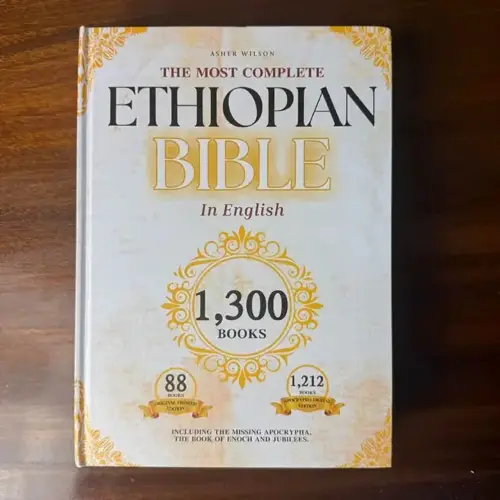
If you don't feel it's the most complete record of the faith you've ever held, full refund. No questions.
Every purchase includes a full historical reference guide that documents the scholarly sourcing, the credentials of the researchers, and the direct lineage from Ge'ez manuscripts to the English text in your hands. Ge'ez — the oldest surviving Semitic language — is a documented, studied field with centuries of academic literature behind it. The translation follows the same source texts Ethiopian monks have copied, read, and lived by since the 4th century. The guide shows you exactly how to trace every page back to its origin. The sourcing is there. Verify it yourself.
The Book of Enoch is quoted by name in the New Testament — in Jude 1:14. The apostles knew this text. They drew from it. The apostle Jude considered it authoritative enough to cite directly in scripture. The Ethiopian Orthodox Church has baptized, prayed, fasted, and raised generations of believers on these texts since 330 AD. The same institution that preaches Christ, observes the Sabbath, and fasts more days per year than any denomination on earth has protected these books for seventeen centuries. The "demonic" label was applied by the same Western theological tradition that edited scripture for a slave-owning king. That label deserves exactly as much trust as the institution that created it.
Your grandmother survived Jim Crow on the verses that were left behind after two separate rounds of editing. That is a testament to her strength — not to the completeness of what she was handed. She was never given the choice you have right now. Reading the full record is not a rejection of her faith. It is the completion of a journey she was denied. The women who describe this experience most clearly say the same thing: they felt closer to their grandmother after reading it, not further. Because for the first time, they understood what she was actually reaching for — and what had been kept from her reach.
The Ethiopian Orthodox Tewahedo Church founded this canon in 330 AD — nearly 400 years before Islam existed, 800 years before the first Crusade, and over 1,200 years before King James commissioned his translation. This church baptizes in the name of the Father, Son, and Holy Spirit. It is the oldest continuously practicing Christian institution on earth. Reading what it has preserved is not leaving Christianity. It is reading the oldest version of Christianity that exists — the one that survived because it was rooted in Africa, where no colonial power could reach it.
Independent testing pulled 22 Ethiopian Bible editions from major online retailers and found the majority failed to contain what their covers promised — books missing entirely, KJV text repackaged with a few additions, or editions assembled from low-quality secondary sources rather than actual Ge'ez manuscripts. The $8 version is not a translation of the Ethiopian canon. This edition was built to one standard: everything the Ethiopian Orthodox Tewahedo Church has protected for seventeen centuries, faithfully translated, with every sourcing decision documented and available to verify.
The feeling you're describing — the fear that more truth will break something rather than build it — is the exact feeling that the edited version of the faith was designed to produce. Knowledge of your full inheritance does not weaken faith. It relocates it. Every woman who describes this experience says the same thing: the God she found in the unedited record was larger, not smaller. More just. More ancient. More aligned with what she had always felt in her bones but could never find the words for inside the church she grew up in. The 30-day money-back guarantee exists precisely for this reason. Read it. If it doesn't bring you closer to the truth you've been searching for, return it. No questions.
Every purchase includes a full historical reference guide that documents the scholarly sources, the lineage from the original Ge'ez manuscripts to the English text in your hands, and the academic credentials of the researchers who completed the translation. Ge'ez — the oldest surviving Semitic language — is a documented, studied field with a body of scholarly literature spanning centuries. The translation was not an interpretation of the faith. It was a linguistic transfer from a source text that has been continuously copied, read, and lived by Ethiopian Christians since the 4th century. The sourcing is verifiable. The guide shows you exactly how to verify it.
A final note from Ayana Osei
Six years of this research have taught me one thing my formal training never did. The women in my data are not asking to believe something new. They are asking for the record their grandmother would have known — if the full version had ever been placed in her hands.
That is a smaller request than it sounds. It is also a more ancient one.
The work behind this investigation does not promise that a book repairs a broken faith. What it does say — clearly, across seventeen centuries of unbroken preservation — is that one specific record, older than Rome, older than colonialism, older than any king's commission, still exists. The same record that Ethiopian monks have copied by hand for seventeen centuries in churches carved into the mountains of northern Ethiopia, still standing, still in use.
The women who find it tend to notice the change before they can name it. They are reading a lineage they were never taught to recognize. They never knew it had been taken. Most of them never will.
What they know is that something in them — older than the church they left, older than the questions they carried, older than any translation — turned its attention back where it belongs.